

A Dashboard Built for the CEO
I built the dashboard for everyone else. The one I needed for myself was always on the back burner.

The first time anyone explained a dashboard to me, they used driving a car as an analogy.
Imagine driving with no instrument panel. No speedometer. No fuel gauge. No little light that tells you the battery is about to quit on you in the middle of nowhere. You’d be moving, sure. You just wouldn’t know how fast, how far you could get, or whether the whole thing was about to die on the shoulder.
5 Takeaways from This Week’s Read
A financial dashboard tells you why your numbers are moving, not just what they are. Top-line figures feel like visibility, but on their own they’re the rear-view mirror with a nice frame around it.
A good dashboard is three to five things, not twenty. The discipline is mostly about what you leave off.
For a small to mid-sized business owner, days cash on hand is the non-negotiable one, and with today’s AI tools it’s finally something you can see at a cadence that is aligned with your current cash position.
The data elements change with the business, the questions don’t. Every owner is answering the same four: How much runway do I have? Am I tracking to plan? Is my biggest bet working? Where is the margin actually coming from?
The data you need is almost always already there, just scattered across reports, spreadsheets, and logins. Pulling it into one view used to be the hard part. With today’s tools, that’s no longer the bottleneck.
That landed for me immediately. And when I moved into a financial leadership position, the first thing I wanted at my fingertips was a dashboard.
But the dashboard I built as a CFO was largely for the board and the executive director. We didn’t have AI back in those days, and pulling together data from disparate sources was always a pain in the you-know-what. So we went with one dashboard a month. That was what the time and the tools allowed.
Then I became the CEO of that same organization, a $12 million nonprofit live entertainment venue. And here is the honest part.
I never built the one I needed for myself.
Not because I didn’t know better. I knew exactly what a CEO-level dashboard should hold, because I had spent years building them for the seat I was now sitting in. The trouble was that the monthly board dashboard was already the thing eating the available time. Building a second one, unique to me and separate from the board version, was the oldest story in the nonprofit playbook: never enough time, never enough resource, a hundred things ahead of it in line. There was data. There were reports. They just never got pulled into one cohesive place where I could see the business at a glance.
It didn’t help that COVID shut our doors right as I took the chair, and every report we’d ever trusted got blown out of the water in a single week. We rebuilt from there. But the dashboard I knew the role required stayed on the someday list.
Top-line is not the dashboard
Most organizations track the big top-line numbers. For me, the top-line numbers I was tracking were:
Gross revenue
Total membership counts
Total dollars raised
Those matter. I am not telling you to stop watching them. But a number on its own only tells you what. It never tells you why. And the why is the whole game.
If gross revenue moved, the question that matters is whether it moved because a strategic initiative you put in motion is working. If you have one in play, that is the thing to measure. Track your progress toward the goal, not just the headline that the goal eventually shows up in.
A dashboard full of top-line numbers feels like visibility. It isn’t. It’s the rear-view mirror with a nice frame around it.
What I’d actually put on it
Three to five things. Not twenty. The discipline of a good dashboard is mostly the discipline of leaving things off.
Here is the short list I’d build for myself today.
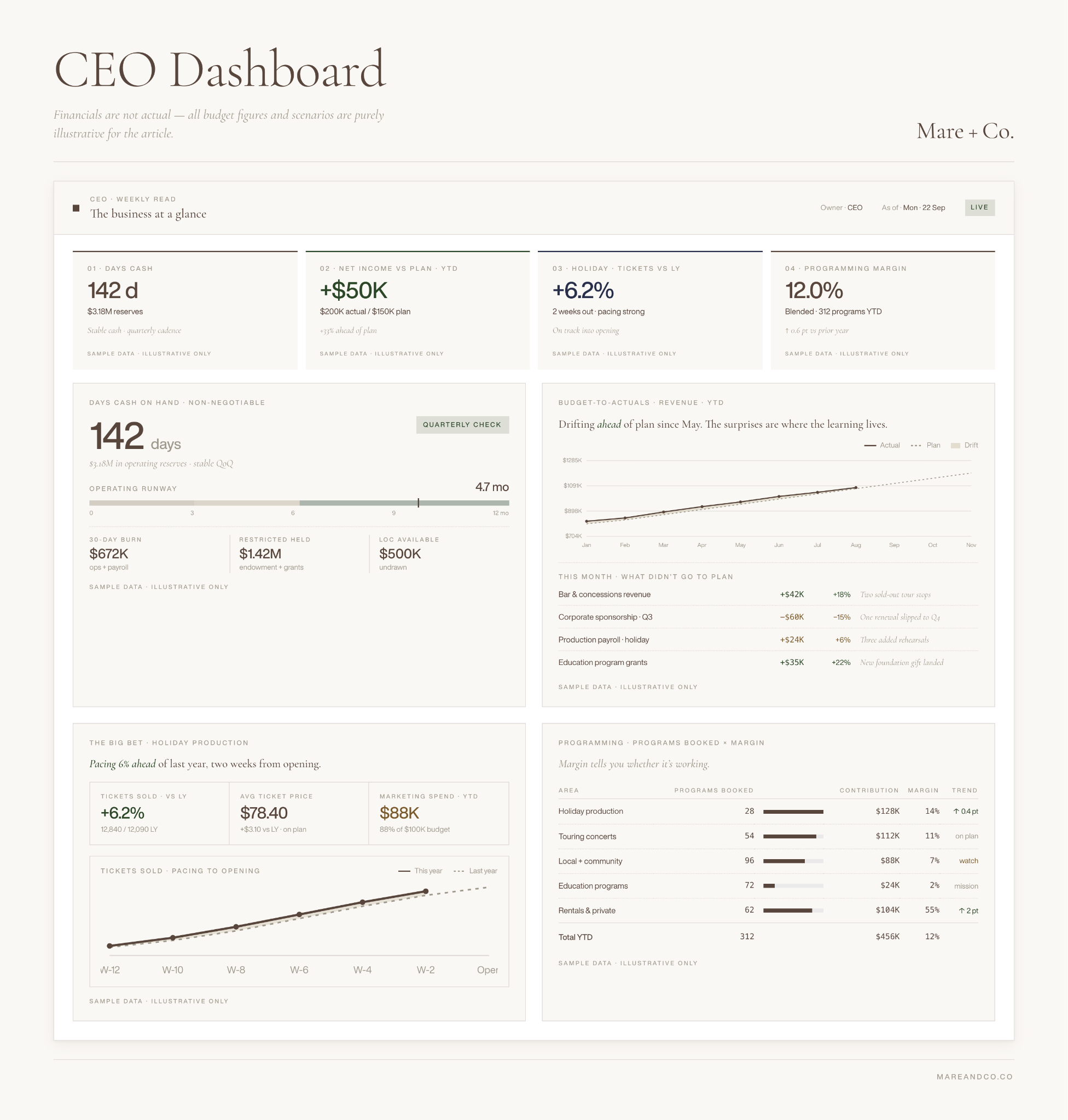
Days cash on hand. In my mind, this is non-negotiable. It earns its permanent spot. (I wrote a whole piece on why tracking cash is one of the most freeing things you can do for yourself and your organization.) How often you check it follows the need, not the calendar. Tight cash is a weekly conversation. Stable cash is a quarterly one.
Budget to actuals, with the variances called out. The bottom line was what I tracked, but the number on its own was never the point. The value was watching how we moved through the seasonality of the business, and then naming the top three to five things that didn’t go to plan that month. Positive or negative, both mattered. A line that came in way over budget taught me as much as one that came in under. The surprises are where the learning lives, and a clean budget-to-actuals view is how you catch them while you can still do something about them.
The one biggest initiative, and your progress against it. For us, that was the annual holiday production. The cash cow of the entire operating budget. I watched three things on it: ticket sales against last year to date, average ticket price, and where we stood on marketing spend. Those told me whether the thing funding everything else was on track.
Programming volume and mix. Our bottom line lived and died by programming, so I tracked the volume and the mix to know we were serving our audience. Then one level deeper, the margin on each programming area. Volume tells you people are showing up. Margin tells you whether it’s working.
That’s the dashboard I wish I’d had. Cash, budget reality, the big bet, and the mix that drives the margin.
All of those numbers were already being tracked. They were just scattered, living in different reports, different spreadsheets, or behind a login I had to go check. The information existed. It just never sat in one place at one time. With today’s technology and AI, all of it can be at your fingertips in short order.
Mine came from a nonprofit venue, so the specifics are mine. Yours will look different. A restaurant owner swaps in covers and food cost; a contractor swaps in jobs booked and gross margin per project. The labels change with the business. The questions underneath them do not: How much runway do I have? Am I tracking to plan? Is my biggest bet working? Where is the margin actually coming from?
What I’m Testing with AI This Week
This is the fun part, and it ties straight into all of the above.
The dashboard image in this week’s piece? I built it with Claude Design, using illustrative data. Not a screenshot of someone else’s software, not a stock graphic. A clean, made-to-order visual of what a CEO dashboard can actually look like, put together in short order.
That’s a small example of the bigger shift. The thing I could never justify the staff time for as a CEO, pulling scattered numbers into one cohesive picture, is now something I can build and maintain without an analyst on retainer. The cost of building the view has dropped through the floor. What it still takes is operator judgment about what belongs on the dashboard in the first place. That part hasn’t changed.
So here’s my question for you
If you’re running an organization right now, what’s on your dashboard? Do you have one at all? And if you do, is it top-line numbers sitting there looking official, or are you drilling into what’s actually making them move?
I’d genuinely like to know what you’re tracking, and what you wish you were.
The path from a wall of disconnected reports to a dashboard that actually tells you the truth is shorter than it used to be. And it’s genuinely walkable.
Just One Thing: I just finished Jeffrey Archer’s The Clifton Chronicles, and I am genuinely a little sad about it. Seven books is a long road to walk with a family, and now I don’t know what to pick up next. So this week’s Just One Thing is really a question back to you. If you’ve read something lately that you couldn’t put down, send it my way. I’d love to hear what everyone is reading right now.
P.S. Helping owners figure out what belongs on their dashboard, and then actually building it, is the heart of what I’m doing at Mare + Co. If that’s a conversation you’ve been meaning to have, my door is open.
-Tina
Building what’s next with clarity, courage and some good tools.
As always you are outstanding young lady